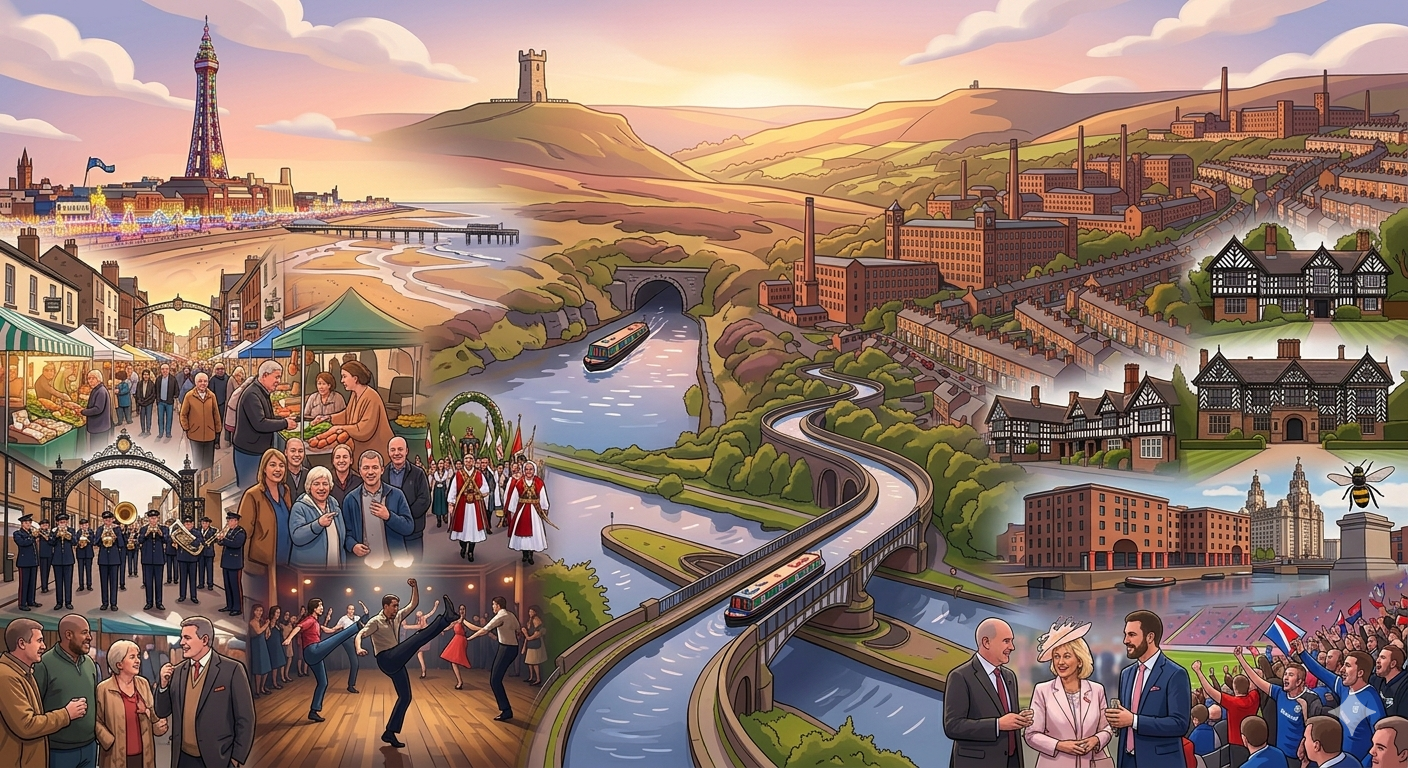
Every region of England thinks it is special. The North West actually is. Not because of what it invented (we have covered that elsewhere) but because of the landscapes, the accents, the subcultures, the landmarks, and the particular way of being in the world that exists here and nowhere else. Here are 50 of them.
The Accents and the Language

1. Scouse The Liverpool accent is one of the most studied and most recognisable in the English-speaking world. Its Irish, Welsh, and Scandinavian influences produce something that linguists have spent decades trying to fully explain and have not quite managed. It is warm, quick, and musical, and it belongs entirely to this city. Take it two miles east across the Mersey and it starts to dissolve. Take it anywhere else in England and it announces itself immediately, like a very friendly alarm.
2. Mancunian Flat vowels, dropped Ts, and a slight upward lilt on statements that makes everything sound faintly defiant. It has shaped the sound of British popular music more than any other regional accent. You can hear it in every band that has ever come out of the city, and it is completely its own thing.
3. Lancashire Dialect Words ‘Barm’ (bread roll), ‘mardy’ (stroppy or quick to anger), ‘gradely’ (excellent), ‘fettle’ (to sort something out). There are hundreds of words rooted in Old Norse and Middle English, still used without irony every single day across the county. They are not affectations. They are simply the language.
4. The Wirral’s In-Between Identity Not quite Scouse, not quite Cheshire, the Wirral has its own distinct accent and identity that sits between two worlds. Locals know instinctively which side of the peninsula they are from. Outsiders can never quite tell.
5. The Terms of Address The broader North West has a repertoire of expressions and terms of address (‘love,’ ‘duck,’ ‘chuck’) that exist in this form nowhere else in England. They are not performed for tourists. They are simply how people speak, and they make strangers feel immediately less strange.
The Landscapes

6. The Forest of Bowland A high moorland plateau of heather, bog, and enormous sky, designated an Area of Outstanding Natural Beauty and visited by almost nobody relative to its size. There are no big car parks, no gift shops, and no queues. And weirdly, very few trees considering its name. Just moorland stretching away in every direction and the kind of silence that reminds you why you came. The Forest of Bowland is one of England’s finest and most undervisited landscapes, sitting quietly between the M6 and the Yorkshire border, waiting to be discovered. Just don’t tell them we sent you!
7. The Wirral Peninsula Squeezed between the Mersey and the Dee, simultaneously urban and rural, industrial and genteel. It manages to feel like three different places at once, which is quite a trick for somewhere you can drive across in twenty minutes.
8. The Fylde The great flat agricultural plain between Preston and the coast. Miles of open sky, market gardens, and windswept fields. On a clear day, Blackpool Tower is visible from twenty miles away. It looks a little like the Netherlands and feels like the edge of everything, in the best possible sense.
9. The Cheshire Plain Flat, fertile dairy country dotted with black-and-white half-timbered farms and red sandstone churches. A deeply English landscape that looks precisely like the England people imagine before they actually get here.
10. Saddleworth Moor The bleak, dramatic moorland straddling the Lancashire and Yorkshire border. Associated with the darkest chapter in North West history, it is also one of the most atmospherically powerful landscapes in northern England. The sky here does things it does not do anywhere else.
11. The Lancashire Coast From Lytham’s windmill and cricket ground to Fleetwood’s fishing heritage and the vast emptiness of the Ribble Estuary, the Lancashire coast is unlike anywhere else in England. It is flat, wide, windswept, and gloriously unfashionable, and it is all the better for it.
The Structures

12. Blackpool Tower Built in 1894, inspired by the Eiffel Tower, and standing 158 metres above the Irish Sea. There is nothing else quite like it on the English coastline, and it is considerably more impressive in person than any photograph suggests. It dominates the Fylde skyline for miles in every direction and has done so for over 130 years. It is one of the great pieces of Victorian civic audacity in England, and it belongs completely to Blackpool.
13. The Barton Swing Aqueduct A canal that rotates. When ships need to pass on the Manchester Ship Canal below, the Barton Aqueduct, carrying the Bridgewater Canal complete with its water, swings on a central pivot. It is the only swing aqueduct still in use in the world, and most people drive over the road bridge next to it without realising what they are looking at.
14. Rivington Pike A stone tower on a moorland summit above Bolton, built in 1733. Below it, largely hidden in the woodland, lie the ruins of Lord Leverhulme’s extraordinary terraced gardens. A Japanese landscape, a ravine garden, a pigeon tower, all slowly being reclaimed by nature. Most people who walk up to the Pike have no idea the gardens are there at all.

15. Port Sunlight William Hesketh Lever built an entire model village for his soap factory workers on the Wirral in 1888. The grand boulevards, formal gardens, art gallery, and extraordinary architecture survive completely intact and are open to visit for free. Port Sunlight is a Victorian utopia genuinely frozen in time, and it is one of the most remarkable places in England that almost nobody talks about. Apart from me. I won’t stop singing its praises!
16. Lyme Park A grand Elizabethan house set in a deer park on the edge of the Peak District, familiar to millions as the BBC’s ‘Pemberley’ in the 1995 adaptation of “Pride and Prejudice.” Visitors still come from around the world specifically for the lake scene. The house and grounds are far more rewarding than one wet Colin Firth, though he certainly helps.

17. Speke Hall A Tudor manor house so thoroughly hidden behind Liverpool Airport that most people have no idea it exists. Half-timbered, moated, and full of priest holes, Speke Hall is one of the finest examples of Elizabethan domestic architecture in England, sitting in the shadow of a runway.
18. The Worsley Mine Water The Bridgewater Canal at Worsley runs bright orange from the iron-rich water draining out of the underground canal system beneath the village. The underground canal stretches for over 50 miles and was once one of the engineering wonders of the industrial world. It is invisible unless you know to look for it, at which point it becomes impossible to stop thinking about.
The Subcultures

19. Northern Soul Born in the Twisted Wheel club in Manchester in the late 1960s and refined at Wigan Casino through the 1970s, Northern Soul is a music and dance culture that is entirely and specifically of the North West. The all-nighters, the talcum powder on the dance floor, the obsessive hunting of obscure American soul 45s, the vests, the high kicks. Nothing else like it has ever existed anywhere. It was working-class, it was passionate, it asked nothing of the mainstream, and it produced some of the most dedicated music lovers England has ever seen. Wigan Casino closed in 1981. The scene never really ended.
20. The Blackpool Ballroom World Blackpool’s Tower Ballroom and Winter Gardens host some of the most important competitive ballroom dancing events in the world. The Blackpool Dance Festival has been running since 1920 and is considered the sport’s unofficial world championship. This is not a hobby here. It is a serious pursuit with a century of unbroken history behind it, and the Tower Ballroom itself is one of the most beautiful interiors in England.

21. Blackpool Illuminations Running since 1879. Miles of lights along the seafront every autumn, drawing millions of visitors and resisting every attempt to make them seem less than they are. No other English seaside town has attempted anything remotely on this scale. Most would not dare.
22. Aintree Ladies Day Every April, thousands of women descend on Aintree Racecourse for Grand National Ladies Day in outfits that have become a cultural phenomenon entirely of their own making. It is fashion as performance, spectacle as sport, and it exists in this specific, exuberant, unapologetic form nowhere else in England.

23. The Rushbearing Festivals Several villages across the Lake District fringe and Lancashire still hold annual rushbearing ceremonies, processing through the streets carrying rushes and flowers to the local church. It is one of the oldest surviving folk traditions in England, and it belongs almost entirely to this corner of the country.
24. The Brass Band Tradition The contest brass band movement was born in the mill towns and mining villages of Lancashire and the surrounding area in the 19th century. The tradition of communities making music together in this specific, disciplined, and passionate form is one of the North West’s great gifts to English culture, and it continues today in towns that have lost almost everything else from that era but have kept the band.
The People and the Identity

25. The Worker Bee of Manchester The worker bee has been the symbol of Manchester since the Victorian era, representing the collective industry of a city built on hard work and shared endeavour. After the 2017 Arena bombing it became something more. A symbol of defiance and communal grief that resonated around the world. You will see it tattooed, painted, carved, and worn across the city. It means something here that it simply cannot mean anywhere else.
26. Emmeline Pankhurst’s Manchester The suffragette movement was founded in Manchester. The Pankhurst Centre on Nelson Street, where Emmeline Pankhurst lived, is still open to visit. The Women’s Social and Political Union was founded in that house in 1903. It changed the course of history, and it started here.
27. Alan Turing’s Legacy Turing lived and worked in Manchester after the war, and the city has honoured that connection more thoughtfully than most. The statue in Sackville Gardens, sitting on a bench with an apple in his hand, is one of the most quietly moving public memorials in England.
28. Marcus Rashford’s Wythenshawe The footballer’s national campaign for free school meals during the pandemic was rooted directly in his own childhood in Wythenshawe. The fact that someone from the North West’s largest council estate became one of the most effective social campaigners of his generation is not an accident of character. It is a product of place.
29. The Grand National and Aintree The most famous horse race in the world takes place in Liverpool every April. The course, with its legendary fences, exists nowhere else. The race itself has a hold on the national imagination that no other single sporting event in England quite matches.
30. Southport Flower Show One of the largest horticultural shows in England, held every August since 1924. Consistently underrated. Always worth the trip. Exactly the kind of thing the North West does brilliantly and forgets to shout about.
The History You Can Still Touch

31. Lancaster Castle’s Courtroom Lancaster Castle served as a working crown court until 2011, making it one of the longest-serving judicial buildings in England. You can stand in the same dock where the Pendle Witches were condemned in 1612. That is not a reconstruction or a re-enactment. That is the actual room, and that is a remarkable thing to be able to do.
32. The Romans at Ribchester The Roman fort at Ribchester, known as Bremetennacum, sits on the banks of the Ribble and contains some of the best-preserved Roman remains in northern England. The museum holds one of the finest Roman cavalry helmets ever discovered. Most people drive through Ribchester on their way to somewhere else entirely.
33. Rufford Old Hall A 15th-century timber-framed great hall in Lancashire, considered one of the finest medieval buildings in the north of England. A young William Shakespeare is believed to have performed at Rufford Old Hall as a boy player. The hall has barely changed since he would have seen it.
34. The Albert Dock’s Grade I Concentration The Albert Dock in Liverpool is the largest collection of Grade I listed buildings in England. When it was regenerated in the 1980s it became one of the most significant urban renewal projects in British history, and demonstrated what post-industrial cities could do with their past rather than demolishing it.
35. The Easter Pilgrimage to Rivington Pike Every Easter Monday, tens of thousands of people walk up to the Pike above Bolton. The tradition has continued unbroken for centuries and has no fully agreed origin. Nobody is entirely sure why it started. Everyone goes anyway. Some things in the North West simply are, without needing to be explained.
The Quirks That Belong Only Here

36. Southport’s Retreating Sea Southport is a seaside town where the sea is frequently not visible from the seafront. The tidal retreat across the flat sands can leave a mile or more of beach between the promenade and the water. It has been baffling first-time visitors and delighting locals for two centuries, and it remains one of England’s most quietly surreal geographical facts.
37. The Pennine UFO Hotspot The moorland between Rossendale, Todmorden, and Saddleworth has one of the highest concentrations of reported UFO sightings in England. The reports have been coming in for decades. Researchers have written books about it. Nobody has produced a satisfying explanation. The sightings keep coming.
38. The Wigan Pier That Is Not a Pier George Orwell immortalised Wigan Pier in his 1937 book ‘The Road to Wigan Pier’. The pier in question was a coal loading jetty on the Leeds and Liverpool Canal in inland Wigan, not a seaside pier at all. The joke was local before Orwell arrived. The name has outlasted the jetty, the coal, and most of the confusion.
39. The Accrington Brick The hard, dense engineering brick produced in Accrington was used to build the foundations of Blackpool Tower, the Empire State Building, and the Blackwall Tunnel, among others. The town itself is modest and largely unvisited. Its product is embedded in some of the most famous structures on earth.
40. The Lytham Windmill A white-sailed windmill standing on the seafront at Lytham, with a cricket ground next door and the Ribble Estuary beyond. It is one of the most peculiarly and perfectly English scenes in the country, and it is in Lancashire, which feels exactly right.
The Character of the Place

41. The Friendliness Genuinely. Sociologists have studied it, visitors always mention it, and people who move away miss it more than they expected to. In Liverpool, Manchester, Bolton, Burnley, and the towns in between, people talk to strangers, and help without being asked. They operate on a baseline warmth that is not universal in England. It is a culture built over centuries of shared hardship and shared pride, and the friendliness of the North West is the most important thing on this list. Apart from perhaps the following…
42. The Hillsborough Families The 35-year campaign for justice following the 1989 disaster changed English law. It changed the relationship between the press and the public (a certain newspaper is still boycotted to this day). And it changed what the word ‘justice’ means in this country.
43. The Dry Wit The North West has produced more standout comedians per square mile than almost anywhere else in England. From Les Dawson to Victoria Wood to Peter Kay, the humour is self-deprecating, and rooted in the texture of life.
44. The Football Intensity The North West contains Manchester United, Manchester City, Liverpool, Everton, Burnley, Bolton, Blackpool, Blackburn Rovers, Preston North End, Wigan Athletic, and several others. The concentration of football culture is unmatched anywhere in the world.
45. The Tradition of Defiance From the Peterloo Massacre to the Suffragettes to the Hillsborough families, the North West has a long and specific tradition of ordinary people standing up to power and refusing to be quiet about it.
Things That Simply Cannot Be Explained Elsewhere

46. The Rain and the Light The North West receives more rainfall than almost anywhere else in England. Locals have developed a relationship with it that is less resignation than philosophy. It is not ignored. It is not complained about for long; it is simply weather, and weather is simply part of being here. But what nobody tells you is what the light does after the rain stops. Golden over the moors, silver over the bay, warm on the red brick of a mill town at four o’clock. In those moments, it is more beautiful than anywhere you have ever been.
47. The Terrace Houses The North West has more surviving Victorian and Edwardian terrace housing than any other region of England. Not as a museum piece, but as homes, lived in, personalised, and loved. The long rows of red brick on hillsides in Burnley, Rochdale, and Salford are one of the defining textures.
48. The Market Town Density Bury, Chorley, Ormskirk, Garstang, Clitheroe, Nantwich, Knutsford, Sandbach (sorry, Garstang, I will get to you soon). The North West has a concentration of functioning market towns, many of which have held their markets continuously for centuries. They are not heritage attractions. They are simply where people go on a Saturday morning, as they always have.
49. The Mills Hundreds of Victorian cotton and woollen mills survive across Greater Manchester, east Lancashire, and the Pennine fringes. Some are flats, some are offices, some are quietly crumbling. All of them tell the same story: that this landscape was the engine of the modern world, and has not forgotten it.
50. The Pride Without the Noise People in the North West are proud of where they are from. It does not require a flag or a slogan. It is there in the way people speak about their town. People who grow up here and move away almost always come back.
Final Thoughts
The North West is a region defined not by a single narrative, but by a complex, layered identity that demands to be experienced rather than just observed. From the resilience forged in its industrial heartlands to the quiet majesty of its moorlands and the persistent warmth of its people, it offers a depth that rewards curiosity. To travel here is to connect with a unique rhythm of life, one that carries its history with pride while continuing to evolve in its own distinct way.


