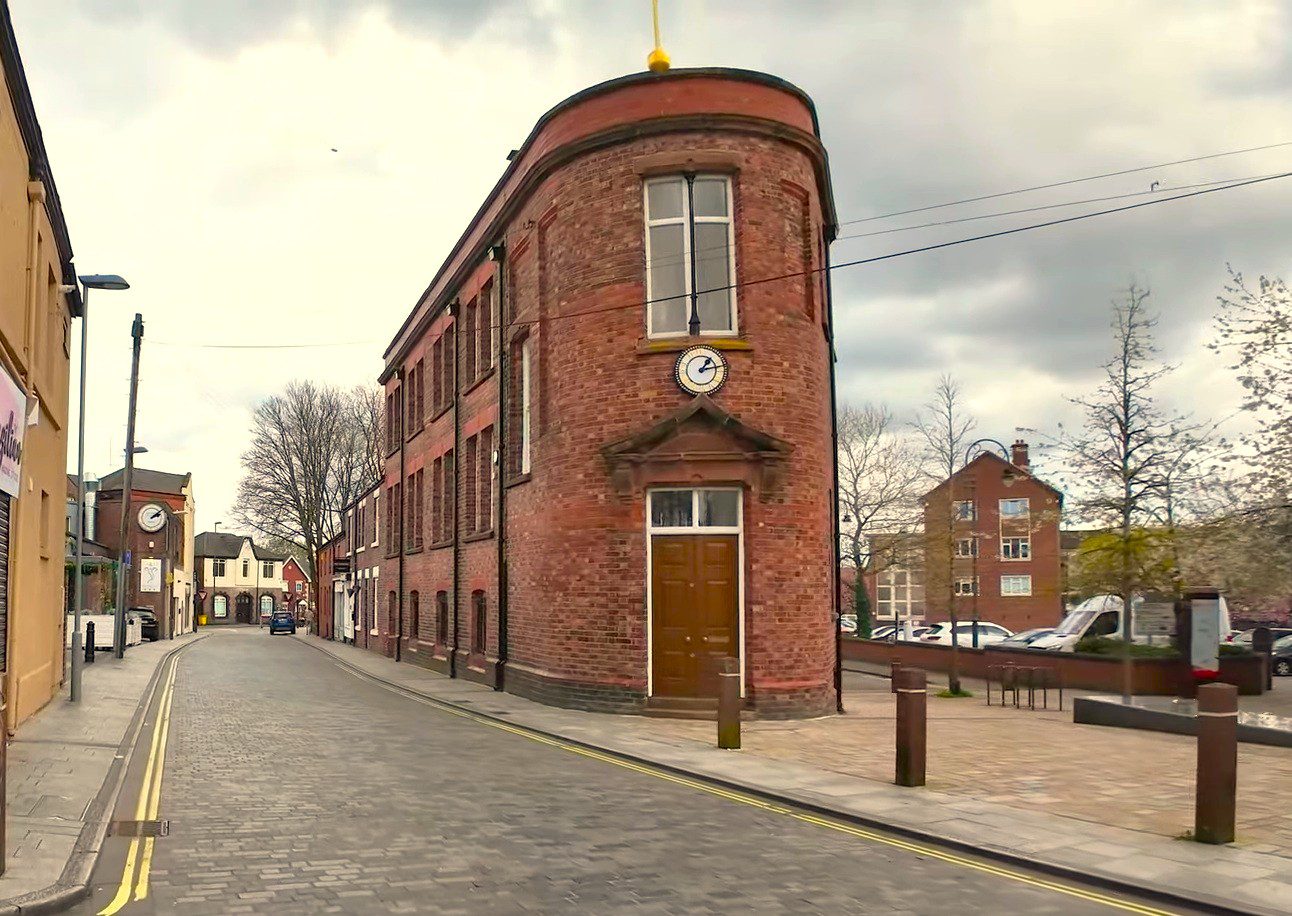
Prescot sits about nine miles east of Liverpool, close enough to feel connected to the city but distinct enough to have its own identity entirely. It is an old market town, one of the oldest in Merseyside. Its high street still carries the bones of a place that has been a centre of local life for centuries. For a long time Prescot was best known for its remarkable role in the English watch-making trade. This industry made it one of the most important manufacturing towns in the country during the 18th and 19th centuries. More recently, the opening of the Shakespeare North Playhouse in 2022 reintroduced Prescot to a national audience. It also gave the town a cultural centrepiece to match its history. The result is a place that is part working market town, part heritage site, and part world-class arts destination.
Prescot At A Glance
| Location | Prescot, Knowsley, Merseyside, North West England |
| Best for | Theatre, local history, watch-making heritage, a genuine market town atmosphere |
| Getting there | Direct train from Liverpool Central (approx. 20 minutes); good road links via M57 and A57 |
| Parking | Town centre car parks off High Street and Eccleston Street; generally affordable and accessible |
| Distance from Liverpool | Approximately 9 miles east; around 20 minutes by car or train |
| Distance from Manchester | Approximately 30 miles west; around 40 minutes by car |
| Distance from Burnley | Approximately 35 miles south-west; around 50 minutes by car |
| Good to know | Shakespeare North Playhouse is a short walk from Prescot train station; check the programme before you visit |
A Town Older Than It Looks
Prescot was granted a market charter in the medieval period and developed as a staging point between Liverpool and the towns of south Lancashire. Its position on a gentle rise made it a natural meeting place. The market cross that still stands in the town centre is a reminder of just how long this has been a place where people gathered to trade. The street pattern in the old town centre is recognisably ancient, with Church Street and Eccleston Street forming the historic core around which everything else has grown.
What gives Prescot its particular distinction is a discovery made by a local historian in 1952. Buried in court records was evidence of a purpose-built indoor playhouse that stood in the town during the 1590s, almost certainly on or near Eccleston Street. It was, in all likelihood, the only freestanding indoor theatre in England outside London at that time. The playing company that used it was Lord Strange’s Men, patronised by the Earl of Derby at nearby Knowsley Hall, and several of those players later became members of Shakespeare’s own company at the Globe. The tantalising possibility that Shakespeare himself may have visited Prescot during his so-called lost years has fuelled considerable academic interest ever since.
The Shakespeare North Playhouse

The Shakespeare North Playhouse opened in July 2022. It immediately established itself as one of the most architecturally striking new cultural buildings in the North West. The exterior is a confident piece of contemporary design, but the real surprise comes when you step inside. At the heart of the building is a traditional timber-framed cockpit theatre. It is modelled on a 1629 design by Inigo Jones, seating around 470 people in galleries that wrap around a central stage. The effect is intimate and slightly theatrical even before a performance begins.
The Playhouse has been awarded Theatre Building of the Year and has drawn audiences from across the country since opening. Its programme mixes Shakespeare with new writing, family shows, and community events. The building contains a studio theatre, and an outdoor performance garden funded in part by the estate of Ken Dodd. It has an exhibition space, and a cafe and bar that are open to visitors whether or not they have a ticket for a show. Dropping in for a coffee and a look around the building costs nothing and is well worth doing even on a casual visit.
Prescot Museum and the Watch-Making Story

The museum on Church Street tells the town’s industrial story with more depth than you might expect. Prescot was producing pocket watch components from the late 17th century onwards. By the early 19th century it was the centre of a cottage industry that supplied parts to watchmakers across England and beyond. The town’s workshops produced files, springs, fusees (it’s a thing, not to be confused with The Fugees). The hand-cut components were made to a level of precision that was remarkable for the period. At its peak the trade employed a significant proportion of the local population.
The museum holds a collection of tools, watches, and documentary evidence that puts this largely forgotten story back in its proper context. Entry is free, and the displays are accessible without any prior knowledge of horology. There is also material covering the town’s Elizabethan theatre history, which makes it a useful companion piece to a visit to the Playhouse.
The Town Centre Today
Prescot town centre is compact and manageable on foot. The market area around the cross and along Eccleston Street gives a clear sense of the town’s layout, and there are independent shops, cafes, and pubs mixed in with the usual run of everyday businesses. It is not a destination for retail in the way that Knutsford or Altrincham might be, but it has a genuine local character that larger, more polished towns sometimes lack.

St Mary the Virgin Church, which stands adjacent to the Playhouse on Church Street, is worth a look in its own right. It is a largely 15th-century building with some fine stained glass and a churchyard that records several centuries of Prescot life. The juxtaposition of the old parish church and the boldly modern Playhouse next door is one of those happy accidents of town planning that works rather well.
Getting the Most from a Visit
Prescot works well as a half-day trip combined with nearby attractions. Knowsley Safari Park is about ten minutes by car and makes for an obvious pairing if you are visiting with children. St Helens is a short drive east and has its own museums and attractions. Liverpool is close enough that Prescot can comfortably form part of a longer day that starts or ends in the city.
Useful Information
If you are planning a visit around a performance at Shakespeare North, it is worth arriving early enough to explore the town before curtain-up. The walk from the train station takes about ten minutes and passes through the old town centre, giving you a sense of the place before you reach the Playhouse. Checking the programme in advance is recommended as the theatre attracts strong demand for popular shows.
| Shakespeare North Playhouse | Prospero Place, Prescot, L34 3AB; check shakespearenorthplayhouse.co.uk for current performances, tours, and cafe opening times |
| Prescot Museum | Church Street, Prescot; free entry; covers watch-making history, local archaeology, and the town’s Elizabethan theatre connections |
| Train services | Merseyrail Kirkby line from Liverpool Central; Prescot station is a ten-minute walk from the Playhouse and town centre |
| Parking | Pay and display car parks in the town centre; free on-street parking available on some surrounding streets |
| Knowsley Safari Park | A ten-minute drive north of Prescot; one of the UK’s largest drive-through safari parks; ticketed admission |
| Eating and drinking | Cafe and bar at Shakespeare North Playhouse; several independent cafes and pubs in the town centre |
| Accessibility | Shakespeare North Playhouse is fully accessible; the town centre is relatively flat and manageable for most visitors |
| Family-friendly | The Playhouse offers family performances and education events; Prescot Museum is suitable for all ages |
| Nearby | Knowsley Hall grounds, Huyton, St Helens, and the wider Knowsley borough are all within easy reach |
Final Thoughts
Prescot is one of those towns that does not shout about itself, and for a long time that served it poorly in terms of visitor numbers. The arrival of Shakespeare North Playhouse has changed the calculation considerably. It brings a building of genuine national significance to a town that already had a history worth telling.
The watch-making story, the Elizabethan theatre, the medieval market town structure, and the new cultural landmark all sit in a surprisingly small area. A walk around the old town, the museum, and the Playhouse makes for a more satisfying day than you might have guessed.


