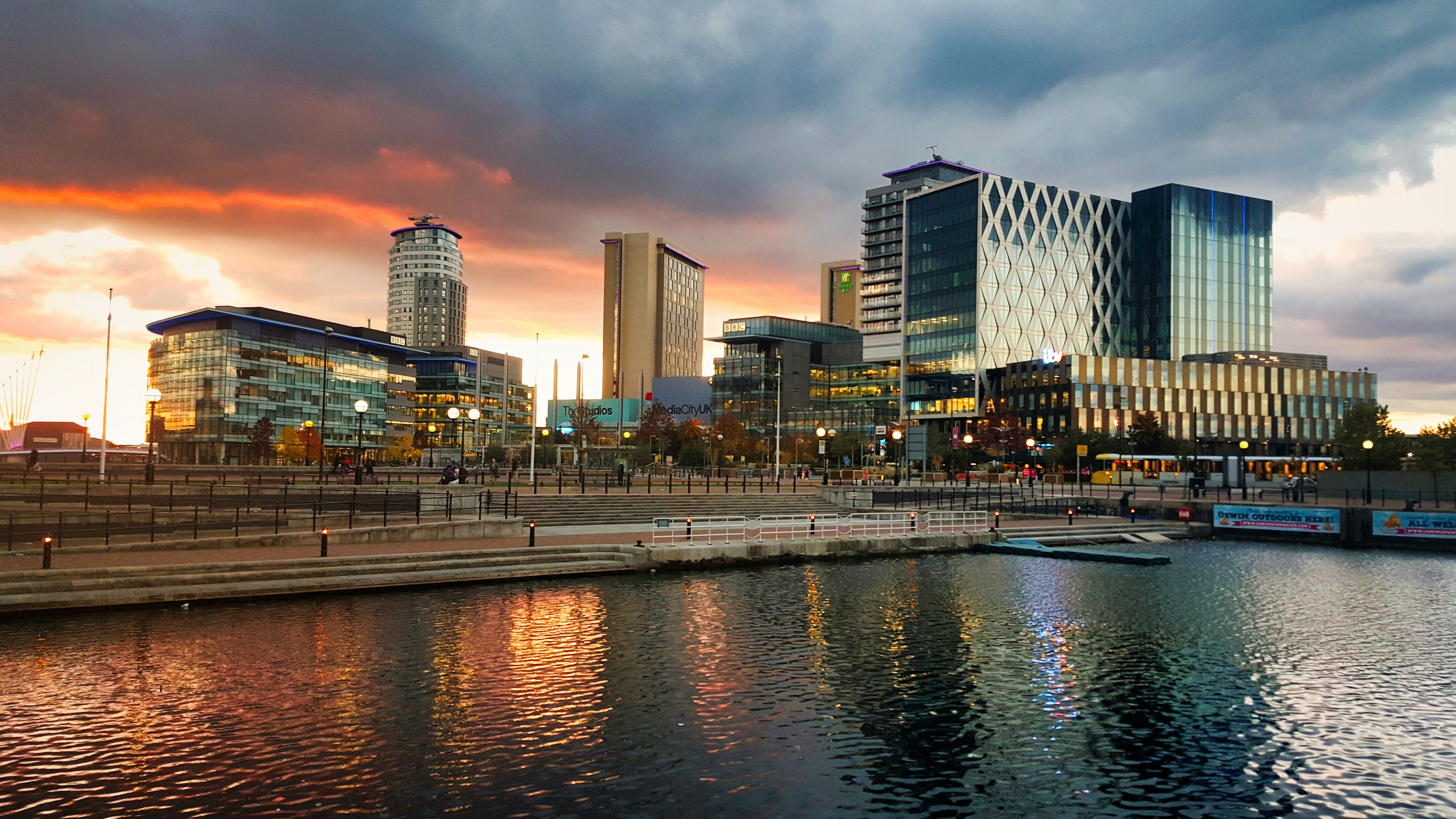
Salford Quays represents the boldest transformation in the North West. For nearly a century, this was the end of the Manchester Ship Canal, a place of heavy industry where ships from across the Atlantic unloaded their cargo.
When the docks closed in 1982, the area was a wasteland of polluted water and abandoned cranes. Today, it is a gleaming landscape of glass, steel, and water that serves as the modern face of the region.
At A Glance: Salford Quays & MediaCityUK
| Feature | Details |
| Location | Salford, M50 3AZ |
| Primary Attractions | Imperial War Museum North & The Lowry |
| Best For | Architecture, free culture, and photography |
| Vibe | Ultra-modern, industrial-cool, and waterfront |
| Transport | Metrolink (MediaCityUK or Lowry Outlet stops) |
| Cost | Free museums (Parking/Tram charges apply) |
The Imperial War Museum North: Shattered Architecture

The most striking building on the Quays is the Imperial War Museum North. Designed by the world-renowned architect Daniel Libeskind, the building itself is a piece of art.
The concept is based on a ‘shattered globe’, with three interlocking shards representing air, earth, and water. It is a jagged, unsettling structure that perfectly reflects the theme of conflict.
Inside, the experience is equally powerful. Every hour, the main gallery space is transformed by ‘The Big Picture’. This is a 360-degree cinematic projection that uses the walls of the museum to tell personal stories of war.
Unlike traditional museums, the floor slightly slopes, and the angles are intentionally disorienting. It is one of the best free days out in the country, offering a visceral look at how conflict has shaped the modern world.
The Lowry: Art and Performance

Directly across the water sits The Lowry, a magnificent steel-clad complex that houses two theatres and a large art gallery.
It is named after L.S. Lowry, the artist famous for his ‘matchstick men’ depictions of industrial Salford. The gallery holds the world’s largest collection of his work, and it is free to enter.

Seeing Lowry’s paintings in the very place that inspired them is a unique experience. He is often dismissed as a simple painter of industrial scenes. This gallery reveals the depth of his work, including his eerie ‘seascapes’ and lonely portraits.
The building itself, with its metallic skin reflecting the changing light of the Manchester sky, is a masterpiece of modern design.
It provides a sophisticated anchor for the Quays, bridging the gap between the area’s gritty past and its cultural future. These structures are the 21st-century descendants of the region’s earlier engineering marvels. To see the ‘cathedrals’ of the industrial age that paved the way for MediaCityUK, visit the Anderton Boat Lift.
MediaCityUK and the Waterfront

A short walk over the pedestrian swing bridge brings you to MediaCityUK. This is the headquarters of BBC North and ITV, and it has a distinct ‘metropolitan’ energy.
The central piazza is a massive open space that often hosts outdoor events and festivals. It is a great place to sit with a coffee and watch the world go by, surrounded by the studios of some of the U.K.’s most famous TV shows.
The waterfront itself is the real star here. The Manchester Ship Canal is still a working waterway, and the sheer scale of the basins is impressive.
You can take a boat trip from the Quays into Manchester city centre, providing a perspective on the industrial history of the canal that you simply cannot get from the road.
The ‘Detroit Bridge’, a massive former railway bridge, has been repurposed as a walkway and serves as a popular spot for photographers looking for that perfect ‘industrial-cool’ shot.
Final Thoughts on Salford Quays
Salford Quays is a testament to the North West’s ability to reinvent itself. It hasn’t forgotten its industrial roots, but it has repurposed them for a new era.
By combining world-class architecture with free cultural attractions and a vibrant waterfront, it offers a day trip that is both educational and visually stunning.
It provides a necessary counterpoint to the Tudor manors and Victorian parks found elsewhere in the region, proving that the North West is just as much about its future as it is about its past.


