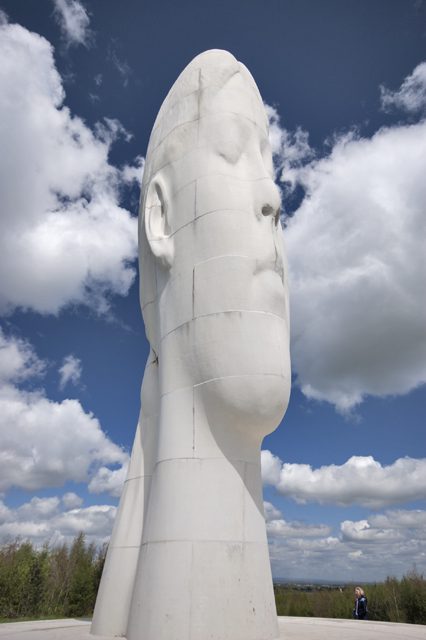
Rising from the site of the former Sutton Manor Colliery, ‘The Dream’ near St Helens is one of the most significant pieces of public art in the North West and well worth a visit.
This 20-metre-high sculpture takes the form of a young girl’s head, her eyes closed in a meditative state. It serves as a gateway landmark for Merseyside and Greater Manchester, visible to millions of motorists who pass it every year on the M62 motorway.
At A Glance: The Dream
| Feature | Details |
| Location | Sutton Manor, St Helens, WA9 4BB |
| Primary Attraction | 20m High Jaume Plensa Sculpture |
| History | Former site of Sutton Manor Colliery |
| Top View | Cheshire Plain, Snowdonia, and Manchester |
| Parking | Free car park on Jubits Lane |
| Accessibility | Steep paths to summit; perimeter is flat |
From Coal to Conservation
The site where The Dream now stands was once a hub of heavy industry. Sutton Manor Colliery was a productive coal mine for over eighty years until its closure in 1991.
For the local community, the closure was a period of significant economic and social hardship.
The Forestry Commission reclaimed the land and transformed into a community woodland.
The creation of the sculpture was part of the ‘Big Art Project’ commissioned by Channel 4. A group of former miners consulted in the selection process.
While many initially wanted a traditional monument to the mining industry, such as a replica of a pit pony or a miner’s lamp, the artist, Jaume Plensa, persuaded them to choose something that looked forward rather than backward.
The girl’s head represents the future and the ‘dreams’ of the generations to come.
Engineering a Modern Icon

The scale of The Dream is immense. It stands on a plinth shaped like a miner’s tally, a subtle nod to the site’s heritage.
The sculpture is made from ninety individual pre-cast concrete panels, which were infused with Spanish dolomite marble.
This gives the surface a brilliant, almost luminescent white finish that contrasts sharply with the black coal that still lies beneath the ground.
The engineering required to secure the sculpture is as impressive as the artwork itself. The foundations extend 38 metres into the earth—nearly twice the height of the sculpture.
This was necessary to ensure stability on the former spoil tip. The face of the girl is elongated. The ideal angle to see it is from below.
This gives the sculpture a different appearance depending on the angle of the sun and the weather conditions of the day.
The Dream in St Helens: Visit for A Panoramic Perspective
The walk up to The Dream from the car park is a steady climb through the young woodland of Sutton Manor. The paths can be steep in places.
Once you reach the summit, the reward is one of the best 360-degree views in the region.
On a clear day, you can see across the Cheshire and Lancashire plains. The view extends to the mountains of Snowdonia in North Wales, the Pennines, and the skyscrapers of Manchester city centre.
It is a place for quiet reflection, away from the noise of the motorway below. The closed eyes of the sculpture encourage visitors to pause and find a moment of peace in a landscape that was once defined by noise and dirt.
Final Thoughts on The Dream
On a visit to The Dream in St Helens, you can see it has successfully achieved what few public artworks manage: it has become a symbol of pride for a community that lost its primary industry.
It is a landmark that demands attention, drawing the eye away from the grey asphalt of the M62 and toward the green hills of the future.
Whether you visit for the strenuous walk or the artistic symbolism, it provides a powerful perspective on how the North West continues to reinvent itself from the ground up.


